
Products
Seat Belt Anchorage Test (SBA) Systems
Advanced Safety Validation for Restraint Systems
The Seat Belt Anchorage (SBA) Test System is a highly advanced solution engineered to evaluate the strength, durability, and compliance of seat belt anchorage points under dynamic and static loading conditions. Designed to meet stringent global safety standards such as ECE R14 and similar regulations, this system plays a critical role in ensuring occupant safety in automotive and mobility applications.
Built on next-generation servo-electric actuator technology, the SBA test system delivers superior control, accuracy, and repeatability—making it an ideal choice for modern testing laboratories and OEM validation facilities
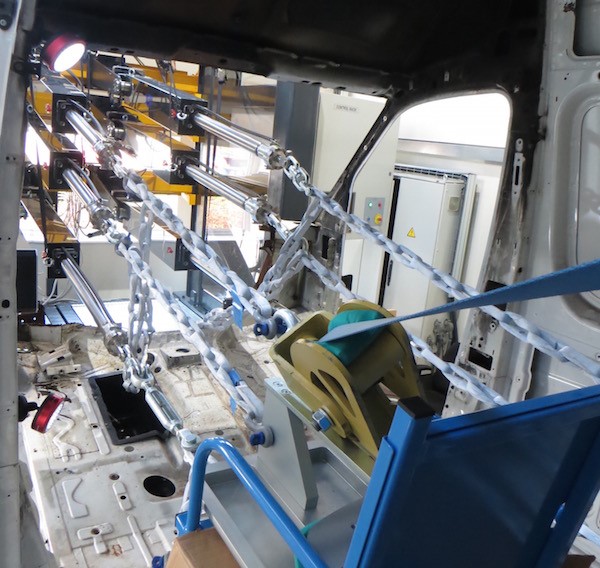
SBA
Features
✓ ECE R14, FMVSS 210, GB14167-2013, ISOFIX…
✓ Up to 9 actuators
✓ Dynamic force of 30 kN at 300 mm/s
✓ Stroke: 1000 mm
✓ Min./Max. vertical separation: 300 mm/2000 mm
✓ Min./Max. horizontal separation: 330 mm/2000 mm
✓ Motorized actuators vertical positioning
Other features under request
Applications
- Automotive seat belt anchorage validation
- Compliance testing for global safety standards (ECE R14, etc.)
- R&D testing for new restraint system designs
- Quality assurance in vehicle manufacturing
Innovative Chain Technology
A standout innovation in this system is the introduction of ultra-light, high-strength polymeric chains, replacing traditional steel chains.
Benefits include:
- Reduced handling effort and improved ergonomics
- High tensile strength with minimal weight
- Increased safety during setup and testing
- Enhanced durability and resistance to wear
This advancement significantly improves both test efficiency and operator safety, especially during repetitive test setups.
Key Advantages
- High Precision & Accuracy
Advanced servo-electric actuators combined with real-time control algorithms ensure highly accurate force application and repeatable test results. - Low Maintenance & Clean Operation
Unlike hydraulic systems, the electric actuation eliminates oil usage, reducing maintenance requirements and ensuring a cleaner, quieter working environment. - Enhanced Operational Flexibility
Expanded actuator positioning range allows testing across various seat configurations and anchorage geometries. - User-Friendly Control System
Intuitive interface with optimized control strategies enables easy setup, execution, and monitoring of complex test profiles. - Remote Operation Capability
Optional wireless control pad enhances operator safety and convenience during testing.